As the 2025 NFL International Series Games concludes, following match-ups in São Paulo, Dublin, London, Berlin and Madrid, rEvolution reflects on the series, explores the effects of such a vast American property successfully activating in Europe, and exposes the untapped opportunities for brands.
For generations, America’s entertainment industry has been one of the country’s most successful exports – a $600billion powerhouse shaping culture and consumer behaviour across the globe. And it has long been the world’s leading exporter. As such, the States’ cultural impact on the world is not debatable.
However, domestic US sports have not always been as effective at crossing borders, and their attempts to win over international audiences have often fallen short. That story is changing – and quickly.
The cultural and technological barriers that once limited global growth are dissolving. With games being played in major European cities, digital platforms transforming fan engagement, and international athletes emerging as cultural icons, American sports are now capturing the imagination of fans worldwide.
So, the big question is what has changed and how have American sports started to cut through? As an American-owned sports marketing business with an office in Europe, we understand this question better than most. Many of rEvolution’s clients are stakeholders in all the major U.S. sports leagues, including the NFL, NBA and/or MLB; we live and breathe this world every day.
In fact, internal discussions on this matter are what prompted us to host a panel discussion in London recently. We did so in conjunction with the European Sponsorship Association (ESA), with representatives from the NFL and the NBA, as well as NetApp, a tech giant, a client of ours, and a significant investor in American sports. Our founder and CEO, John Rowady, was also on the panel, which delved into how and why fandom in Europe continues to go from strength to strength.
Moderated by our Head of Europe, Ross Arnold, the session explored how U.S. leagues are redefining fandom, reshaping sponsorship, and opening powerful new storytelling opportunities for brands internationally. Alongside John and Ross were Kimberley Bailey, Global Partnerships at the NBA, Hannah Salwen, Global Partnerships, NFL, and Vinga Pálsdóttir, Global Sponsorships, NetApp.
Here are some of the key insights from that discussion.
1. Scale meets strategy: the long game of growth
Few global sports properties can match the financial strength and therefore international reach of the NFL and the NBA. In turn, as they focus their interests on geographical expansion, this has enabled them to prioritise long-term growth and investment in youth engagement and digital infrastructure rather than chasing quick wins. Or, in other words, they can afford to play the long game.
Kimberley Bailey from the NBA noted: “About 40% of our fans are under the age of 35. We’re lucky to have attracted so many millennial and Gen Z fans. The NBA is now the second most followed sport in EMEA, behind football.”
By building relationships with younger audiences who actively choose their teams – rather than inheriting them – these leagues are creating lifetime value for both fans and the brands that connect with them.
2. Global stars, local heroes
Fandom thrives on identification. Seeing “one of your own” succeed bridges continents and cultures. The NBA and NFL’s increasing diversity has helped to fuel that connection.
“Five of the last seven NBA MVPs have been from outside the US,” noted Kimberley.
International talent isn’t just about player recruitment, it’s brand alchemy. Each global star becomes an ambassador, opening doors to new audiences and local narratives that brands can authentically tap into.
3. Bringing the game and the experience to the fans
Historically, time zones, media access and geography limited international growth. Today, leagues are turning those barriers into opportunities.
“We’re building events that engage fans throughout the entire season,” said Hannah Salwen, NFL. “This year we hosted seven kickoff events across key markets – city tours, merchandise pop-ups and experiences that let fans literally touch the game.”


Similarly, as explained by Kimberley, the NBA is expanding participation at every level: “From three-on-three tournaments to the Jr NBA and the WNBA, we’re giving fans new ways to play and participate.”
For brands, these hybrid experiences, which blending elite competition with community activation, create immersive storytelling environments that go far beyond traditional sponsorship.
4. Fans withour borders
One of the most compelling insights from the panel was how fluid fandom has become. In Europe, club allegiance traditionally runs along geographic lines, but American sports are rewriting that rulebook.
As John Rowady (below) put it: “When NBC started showing Premier League games in the US, many of us became fans of English clubs without any local connection. The same thing is happening here with the NFL and NBA. Fans in Europe are choosing teams based on stories, players and culture – not just proximity.”
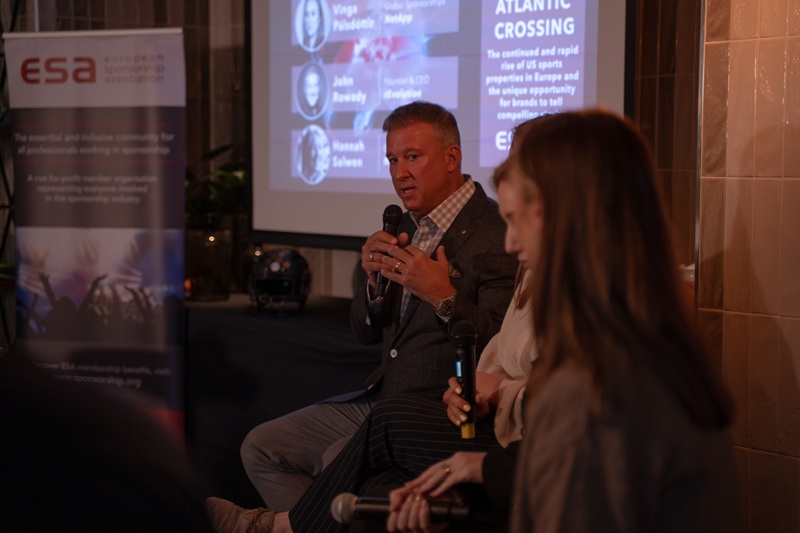
That shift unlocks unprecedented flexibility for brands. Where loyalty is chosen, not inherited, emotional storytelling, rather than location, becomes the most powerful engagement tool.
5. Local integration, global activation
The days of “fly-in, play, fly-out” are gone. Both the NFL and the NBA are embedding themselves into European culture, through community programmes, business partnerships and creative collaborations with local/regional businesses.
“We’ve done city tours because we want to embed ourselves into local culture,” said Salwen. “Our fan base today is younger and more diverse than ever before.”
Meanwhile, the NBA continues to use its global footprint to connect sport, travel and lifestyle: “Our fans love to travel, and many are affluent enough to do so. That’s why partnerships with destinations like Abu Dhabi and brands like Booking.com make perfect sense.”
For marketers, this means aligning with leagues that don’t just visit local markets, they live in them, creating enduring brand equity.
6. Technology: the invisible stadium
With most fans consuming content digitally, technology has become the new arena.
“Ninety percent of our fans will never attend a live NBA game,” noted Kimberley.
Social media, streaming, fantasy leagues and data visualisation tools have blurred the lines between spectator and participant. For brands, this means new, measurable ways to tell stories, across multiple touchpoints and time zones, without having to be physically inside the stadium.

As Vinga Pálsdóttir of NetApp (pictured above), a major global partner of the NFL, shared: “The push into AI and NFL’s global expansion required a unified data infrastructure. Our partnership started there, but it’s grown into a shared narrative – we had already earned their trust technically, so formalizing a partnership to power our aligned global narratives and expansion strategies made sense.
“It’s working for both parties and has for example opened doors for us at NetApp to build similar relationships with individual teams too.”
The lesson? Technology isn’t just a backbone for engagement; it is a storytelling platform.
7. From sponsorship to storytelling partnerships
Sponsorship models have evolved dramatically. Rights holders aren’t selling logos; they’re building ecosystems of shared values and cultural relevance.
“We make sure partnerships start long before the ink is dry,” said Hannah of the NFL. “Alignment of goals and values is everything.”
As Kimberley from the NBA added: “The best agencies aren’t just brokers. They’re advisors who understand both sides, ensuring partnerships grow together. That’s where the magic happens.”
For brands, this new model offers more than exposure, it offers narrative ownership within some of the world’s most dynamic fan communities.
A new era: shared stories, shared growth
It’s taken time, persistence and innovation, but American sports have finally found their global rhythm. What began as a cultural export has evolved into a global community, powered by youth engagement, digital immersion and authentic local connection.
As US sports continue to expand their presence and influence across Europe, the opportunities for connection, creativity and cultural impact will only grow stronger. Leagues, brands and fans are no longer separated by geography or time zones, they are part of a shared, dynamic ecosystem where engagement is personal, participation is global, and stories travel across borders in real time.
For brands willing to embrace this landscape with authenticity and imagination, American sports offer a platform unlike any other: one where audiences are active participants, loyalty is earned through experience, and every interaction contributes to a narrative that transcends continents.
The Atlantic may have once been a barrier, but today it is a bridge – and the journey of fandom, storytelling and shared growth is just beginning. For global and/or predominantly ex-US brands looking to align with progressive and established sports with ambitions for international growth, ‘US sports’ are becoming a much more viable and differentiated option.
rEvolution is right at the heart of it and excited about the journey we, our partners, and the stakeholders are on. So, as our colleagues in the US would say, ‘let’s go!’.