Hark has today published The Fan Gap, a new UK-wide insight study revealing the key factors shaping girls’ sport fandom – and the experiences that cause many to lose connection during their teenage years.
Drawing on the voices of 1,504 young people aged 11-17, as well as Hark’s national Teacher Panel, the research uncovers the pathways that draw girls into becoming sports fans – and the gaps that cause many to drift away during adolescence.
Key findings from The Fan Gap:
- 40% of young people can’t name a single sportswoman, highlighting a major visibility gap despite huge recent progress across women’s sport.
- Girls’ fandom drops sharply during secondary school – from 62% of 11–13-year-olds to 50% of 16–17-year-olds, while boys’ fandom remains steady at around 75%.
- 80% of girl sport fans want to know more about sportswomen, and 76% want stories about athletes who “look and sound like me”.
- 1 in 3 girl fans do not know where to watch women’s sport, and 40% struggle to find highlights or clips.
- Hark calls for earlier action, richer storytelling and school-led interventions across all sports to build the next generation of fans.

Girls aren’t short on passion, they’re short on pathways
Hark’s new research reveals a striking challenge at the heart of sport: 40% of young people cannot name a single sportswoman. This signals a major visibility gap at a time when women’s sport has never been more prominent, showing that many young people are still not regularly encountering women athletes in their everyday lives.
The findings also show a significant shift in girls’ fan identities as they move through secondary school. While 62% of girls identify as sports fans at ages 11–13, this falls to 50% by ages 16–17, in comparison with boys, where fandom levels stay consistently high at around 75%. These insights reveal a moment where many girls’ early enthusiasm for following sport fades – and where the sector has a major opportunity to keep more of them connected as fans.
For some young people, women athletes are still less visible or less commonly talked about – one of several factors that can influence how easily girls stay connected as fans. A 14‑year‑old observed, “It’s easier to name male sportspeople because they get shown a lot more on TV.” Another, aged 17, said, “I play badminton twice a week – but I can’t name a player.”
The research highlighted other gaps too. 1 in 3 girl fans do not know where or when women’s sport is broadcast, and 40% struggle to find highlights or clips. As one girl put it simply: “If it was on, I’d watch it.” Access is only part of the challenge – some girls also described feeling judged or not taken seriously as fans, echoing teachers’ concerns about how gendered expectations and stereotypes are shaping young people’s confidence to engage.
A significant opportunity for all sports
One of the study’s most striking findings is the sheer breadth of sportswomen girls recognise when visibility happens and stories reach them. Across all responses, young people named 177 different favourite sportswomen spanning 34 sports and 33 nationalities – from football, tennis and athletics to swimming, cricket, netball and rugby union.
Football was the strongest performer, with 51% of all favourite mentions going to footballers, particularly England’s Lionesses, but the wide range of sportswomen across many sports shows a major cross‑sport opportunity: when girls have access to role‑model stories, they develop varied, personal and long‑lasting sport identities.
And the appetite for these stories is huge. 80% of girl sport fans want to know more about sportswomen, and 76% want stories about athletes who “look and sound like me”.
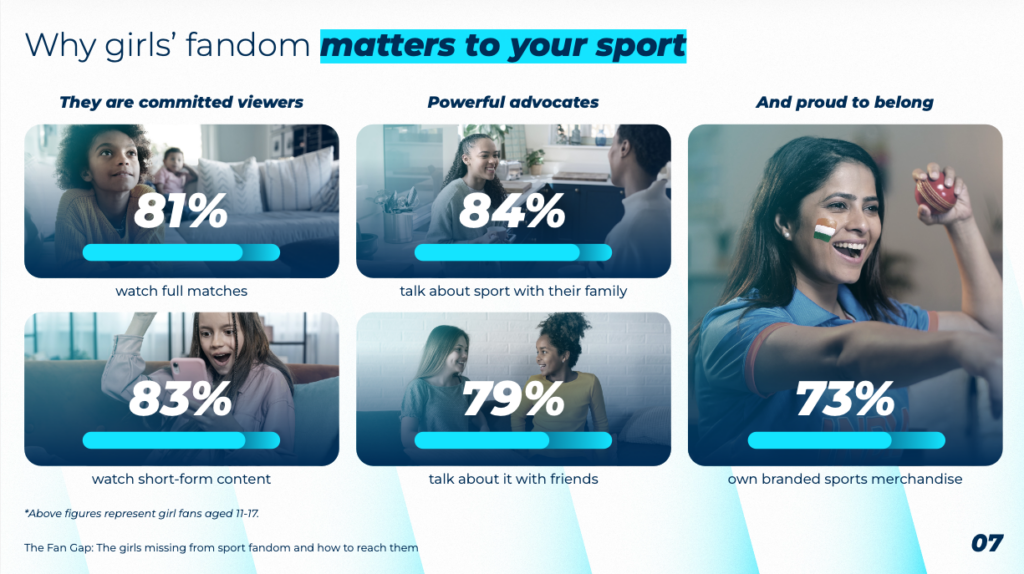
Being a fan is hugely valuable for girls. 89% of girl sport fans say it makes them happier, 80% say it boosts their confidence, and 83% say it helps them build friendships. Together, these benefits underline why retaining girls’ connection to sport through their teenage years matters so much – because when that connection weakens, they risk missing out on experiences that support their wellbeing, confidence and sense of belonging.
Responding to the findings, Kathryn McColl of Hark said: “Girls aren’t missing from fandom because they don’t care – they care deeply. As a sector, we need to do more to share the information, stories and role models they want to hear about.
“When girls see themselves in sport, their confidence grows, their engagement strengthens and their belief in their place in sport transforms. This isn’t about motivation; it’s about giving them the access and relevance they’re asking for.”
McColl continued: “We’re already working with brilliant clients, rights holders and brands across a wide range of sports who are doing important work to respond better to girls’ needs. This research helps shine a light on where else the sector can and should focus if we’re going to turn more girls into fans and keep them following sport as they progress into adulthood.
“Girls represent one of sport’s biggest untapped audiences. If the industry wants to build the fans of tomorrow, it needs to invest in the places where fandom begins.”
What needs to change
The findings suggest a clear path forward to close the Fan Gap:
- Act earlier: Primary and early secondary school are pivotal for shaping interests and identity.
- Listen to young people: Their experiences reveal the moments where connection grows, and where it slips.
- Tell richer stories: Girls want journeys, not just results, and they want role models across many sports.
- Bring boys with you: Exposure to women’s sport shifts attitudes and normalises girls’ fandom.
- Use schools: Teachers see the power of sharing sportswomen’s stories and want more tools to use them.
The full report is available on Hark’s website here: http://harklondon.com/the-fan-gap-report
-ENDS-
Methodology
This research reflects the views of 1,504 young people aged 11–17 across the UK. The sample was nationally representative. 50% identified as boys, 49% as girls and 1% identified outside of boy or girl. Findings were supported with survey data from Hark’s national Teacher Panel.
About Hark
At Hark, we help brands build meaningful relationships with young people, and sport is one of the most powerful ways to do it.
Sport shapes confidence. It shapes identity. It shapes the moments young people remember. That’s why we created Hark Sport, a dedicated sub‑brand for clients who want to use sport to inspire, include and elevate the next generation.
We work where young people already learn, grow and form their interests – schools, homes and communities. Here, we help clients build relevance and reputation, while making a real difference to young people’s lives.
For more information, visit Hark’s website and Linkedin.
Media Contact
Natalia Pink, natalia.pink@harklondon.com
Freya Smellie, freya.smellie@harklondon.com