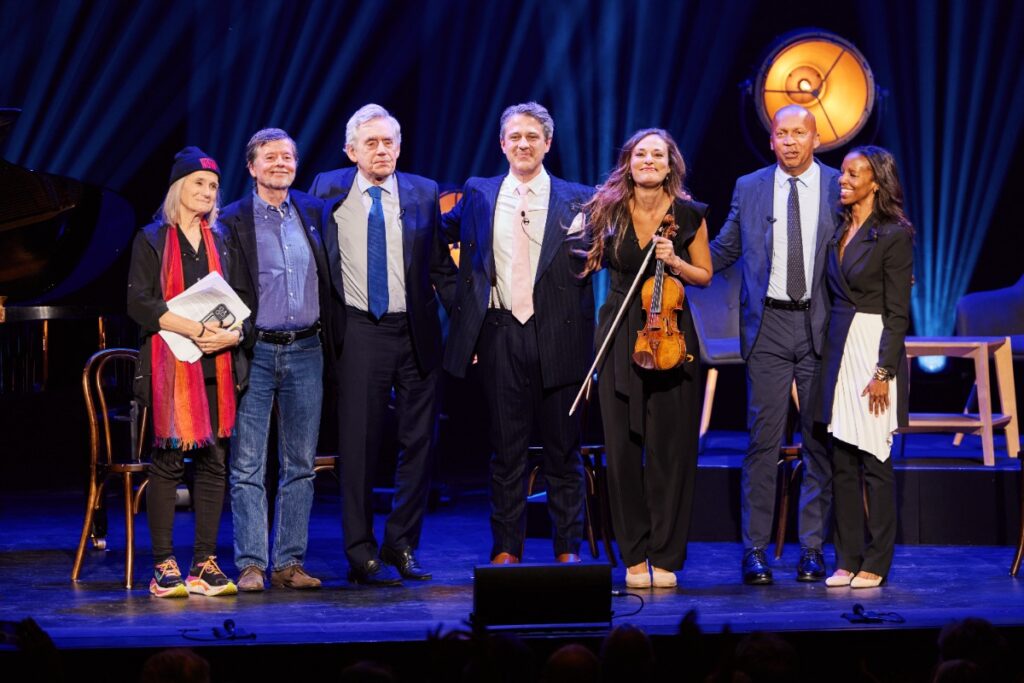
- A major new global poll unveiled at Edinburgh International Festival’s Global Ideas Stage has found that 68% of people worldwide say culture gives them hope. Focaldata surveyed 35,000 people across 34 countries for the research.
- The Global Ideas Stage brought together some of the world’s leading thinkers, artists and cultural voices: Harvard professor and award-winning author Sarah Lewis, Director of Panmure House and Adam Smith Chair Adam Dixon, Festival Director Nicola Benedetti, Former Prime Minister Gordon Brown, filmmaker Ken Burns, lawyer and social justice activist Bryan Stevenson and journalist Amy Goodman.
- Tickets to all events in the 2026 Edinburgh International Festival, running 7-30August, are available at www.eif.co.uk.
A major new poll of 35,000 people across 34 countries, commissioned to coincide with the inaugural Global Ideas Stage at the 2026 Edinburgh International Festival, has found that more than two-thirds of people worldwide have relied on the arts to keep them hopeful.
The poll, the largest of its kind ever undertaken on this subject, was revealed at the Global Ideas Stage, the International Festival’s new flagship event held in collaboration with Panmure House, the last home of Scottish economist and philosopher Adam Smith. Seeking to demonstrate why the arts matter in today’s world, it found that 68% of people say an individual cultural moment, whether a live music performance, a book, a work of art, a film, or a piece of theatre, has helped them feel more hopeful in the face of an uncertain future.
Among people who say a piece of culture ‘definitely’ made them feel more hopeful, 26%, (nearly one in four), say people in their community always pull together in a crisis. That is more than double the rate among people who say culture helped only “a little” (12%), and almost three times the rate among those who say culture did not help at all (9%).
Conducted by Focaldata, the research found that people whose sense of hope is inspired by culture are twice as likely to believe humanity can keep building a better world for the next generation. The same group is also twice as likely to say people in their community will pull together in a crisis.
Curated and hosted by Festival Director Nicola Benedetti, Harvard professor Sarah Lewis and Panmure House Director Adam Dixon, the 2026 Global Ideas Stage brought together Former Prime Minister Gordon Brown, filmmaker Ken Burns, lawyer and social justice activist Bryan Stevensonand journalist Amy Goodman to offer a bold new form of public discourse.
Inspired by this year’s Festival theme, All Rise, and the coffeehouse culture of Enlightenment Edinburgh, the Global Ideas Stage was presented for a live audience at the newly refurbished King’s Theatre. In a series of intimate dialogues, special performances and an invigorating panel discussion, the speakers reflected on the 250 years since the US Declaration of Independence and the publication of Smith’s ‘The Wealth of Nations’, and considered the interdisciplinary role of arts and culture in shaping society’s moral imagination and future.
Nicola Benedetti, Edinburgh International Festival Director, said: “This timely polling is itself inspiring and affirming of the work we do. It shows the essential importance of arts and culture to our shared human condition, to our innate optimism, and to the practice of resilience.
“This poll should galvanise politicians and policy makers to recognise, commit to, and invest in culture to improve the lives of global citizens.”
Former Prime Minister Gordon Brown, said: “When things seem most difficult and uncertain, what gives us hope?
“What this vital poll shows is that art, music and literature are essential to give us hope about the future, because they inspire us to actually do the things that perhaps we feel we would not be capable of, and – because they are shared in common – they inspire us to come together. They offer the players and the stages, the architecture and history that will lay the foundations and signpost the way to the more hopeful future we so desperately need.”
Director of Panmure House and Adam Smith Chair, Adam Dixon, said: “This poll clearly shows that people are looking to the arts not only for inspiration, but for hope.
“At a time of profound global change, there could be no better moment for Panmure House and the Edinburgh International Festival to come together and create a platform for meaningful dialogue and fresh perspectives.
“Drawing on Edinburgh’s rich tradition of debate and discovery, we’re proud to help bring leading thinkers, artists and audiences together to explore the defining questions of our time.”
Tickets to all performances in the 2026 Edinburgh International Festival are available at www.eif.co.uk.
-ENDS-
Media contacts:
Isabella Feros, Media Manager, isabella.feros@eif.co.uk
Hugo Mintz, Head of Communications and Digital, hugo.mintz@eif.co.uk
press@eif.co.uk / eif.co.uk
Former Prime Minister the Rt Hon Gordon Brown:
Gordon Brown is the United Nations Special Envoy for Global Education and WHO Ambassador for Global Health Financing. He served as Prime Minister of the United Kingdom from 2007 to 2010 and as Chancellor of the Exchequer from 1997 to 2007, making him the longest-serving Chancellor in modern history. As UN Special Envoy for Global Education, he works with governments, international institutions and the private sector to mobilise investment in education worldwide. Gordon holds a PhD in History from the University of Edinburgh. He lives in Scotland.
Filmmaker Ken Burns:
Ken Burns has been making documentary films for fifty years. Since the Academy Award nominated Brooklyn Bridge in 1981, Ken has gone on to direct and produce some of the most acclaimed historical documentaries ever made, including The Civil War; Jazz; The National Parks: America’s Best Idea; Prohibition; Country Music; and, most recently, The American Revolution. Ken’s films have been honoured with dozens of major awards, including seventeen Emmy Awards, two Grammy Awards and two Oscar nominations.
Broadcast journalist Amy Goodman:
Amy Goodman is the host of Democracy Now!, a daily, independent, award-winning news programme airing on over 1,500 public television and radio stations worldwide, with millions of subscribers across all major social media platforms. Amy was the first journalist to receive the Right Livelihood Award for ‘developing an innovative model of truly independent grassroots political journalism.’ Goodman has co-authored six New York Times bestsellers, and is the subject of the new documentarySteal This Story, Please!, by Oscar-nominated directors Tia Lessin and Carl Deal.
Lawyer and social justice activist Bryan Stevenson:
Bryan Stevenson is the founder and Executive Director of the Equal Justice Initiative, a human rights organisation in Montgomery, Alabama, and has initiated major new anti-poverty and anti-discrimination efforts that challenge inequality in America. Mr. Stevenson led the creation of EJI’s highly acclaimed Legacy Sites, including the Legacy Museum, the National Memorial for Peace and Justice, Freedom Monument Sculpture Park and Montgomery Square. He is the author of the critically acclaimed New York Times bestseller,Just Mercy, which was adapted as a major motion picture.
Award-winning author and Harvard University Professor Sarah Lewis:
Sarah Lewis is the John L. Loeb Associate Professor of the Humanities and African and African American Studies at Harvard University, and founder of Vision & Justice, a publishing and research initiative examining the role of visual culture in America’s democracy. Her award-winning books include The Unseen Truth: When Race Changed Sight in America and the bestseller The Rise: Creativity, the Gift of Failure, and the Search for Mastery. Named to the 2026 TIME List: The Closers for her work toward equality in the United States, her mainstage TED talk Embrace the Near Winhas received over three million views. Before joining Harvard, she held curatorial positions at MoMA New York and Tate Modern London.
Violinist and Edinburgh International Festival Director Nicola Benedetti:
Nicola Benedetti is one of the most sought-after violinists of her generation, performing with the world’s leading orchestras including the London Symphony, Chicago Symphony, San Francisco Symphony, and Orchestre de Paris. A GRAMMY Award-winner for Best Classical Instrumental Solo (2020) and two-time Classical BRIT Award-winner, she records exclusively for Decca and is the founder of The Benedetti Foundation, a charitable organisation dedicated to music education. Appointed CBE in 2019 and the youngest ever recipient of the Queen’s Medal for Music, she became Director of the Edinburgh International Festival in 2022.
Director of Panmure House and Adam Smith Chair, Adam Dixon:
Professor Adam Dixon is an American professor based in Edinburgh, where he leads Panmure House, the final home of Adam Smith. A sought‑after speaker and moderator, he addresses geopolitics, economics, and global affairs. As the Adam Smith Chair, he applies Smith’s insights to modern challenges, from government intervention to global competition and business ethics. An Oxford‑trained political economist, he offers clear, informed perspectives on power, priorities, and the forces shaping today’s world.
The Global Ideas Stage is supported by James and Morag Anderson.
Further Questions on the Survey:
KEY FINDINGS
Focaldata interviewed 35,000 adults across 34 countries.
Key findings include:
- 68% of people say a piece of culture, whether music, art, a film, a book, or a performance, has helped them feel more hopeful when the future felt uncertain.
- Among people who say a piece of culture “definitely” made them feel more hopeful, 26%, (nearly one in four), say people in their community always pull together in a crisis.
- That is more than double the rate among people who say culture helped only “a little” (12%), and almost three times the rate among those who say culture did not help at all (9%).
- Among people who say a piece of culture “definitely” made them feel more hopeful, 62% say it is definitely possible to build a better future for the next generation.
- Compared to 36% of people who say culture helped only “a little”, and 24% of people who say culture did not help at all.
- People who found culture made them hopeful were more than twice as likely as those who found it unhelpful to see a better future as achievable.
METHODOLOGY
Which 34 countries and how were they chosen?
Countries, listed alphabetically: Argentina, Australia, Brazil, Canada, Chile, China, Colombia, France, Germany, Ghana, Hungary, India, Indonesia, Italy, Japan, Kenya, Mexico, Morocco, New Zealand, Nigeria, Norway, Philippines, Poland, Romania, Saudi Arabia, Singapore, South Africa, South Korea, Spain, Sweden, Turkey, United Kingdom, United States, and Uruguay.
These were chosen to be reflective of a cross-section of countries from the global north and south and samples reflect nationally representative statistics.
What methodology was used for the survey?
All respondents participated via online panels, where volunteers take surveys and are compensated for their time. The same methodology was used consistently across all 34 countries.
Fieldwork was carried out concurrently across all countries between 21 July and 5 August 2026.
The question was identical across all countries but translated into the local language where the main language is not English:
“Think of a time when the future felt uncertain, did a piece of culture — music, art, a film, a book, a performance — help you feel more hopeful?”
Response options:
1. Yes, definitely
2. Yes, a little
3. No
4. I can’t recall a time like that
The Global Ideas Stage
New for 2026, the Global Ideas Stage brings a bold new form of public discourse to the Edinburgh International Festival programme. In collaboration with Professor Adam Dixon and Panmure House, the last home of Adam Smith, and curated and hosted by Harvard University professor and award-winning author Sarah Lewis, alongside Festival Director Nicola Benedetti, the inaugural Global Ideas Stage united extraordinary thinkers and cultural leaders on stage at the newly redeveloped King’s Theatre. Nicola Benedetti, trumpeter and composer Wynton Marsalis, Scottish mezzo-soprano Beth Taylor and pianist Hamish Brown, and the vocal group Jason Max Ferdinand Singers all also performed as part of the Global Ideas Stage.
About Edinburgh International Festival
Edinburgh International Festival is the original festival. It’s the one that started it all, the igniting spark that established Edinburgh as the world’s Festival City.
This year’s International Festival takes place 7–30 August 2026, under the direction of Festival Director and Scottish violinist Nicola Benedetti. Benedetti’s vision for the Festival is to create the deepest level of experience, through the highest quality art, for the broadest possible audience.
The Edinburgh International Festival was founded in 1947, the inspired idea of Rudolf Bing, a cultural pioneer and Jewish refugee, working with a group of civic and artistic leaders. Together, they created a festival that transcends political boundaries through a global celebration of the performing arts.
Over the following 79 years the International Festival’s hand-picked programme of world-leading dance, opera, music and theatre has continued to bring people of different cultures and viewpoints together every August. Meanwhile, the International Festival’s sister festivals have grown up around it – each of them contributing to the atmosphere of unparalleled excitement that transforms the city each summer.
Shining far beyond what you see on stage, the Festival also offers year-round pathways for people of all ages and backgrounds to discover and participate in live performance. Learn more at eif.co.uk/about.
Panmure House
Panmure House is the final home of Adam Smith, one of the most influential thinkers of the Scottish Enlightenment, and today serves as an independent think tank affiliated to Heriot-Watt University and Edinburgh Business School. The residence where Smith revised The Wealth of Nations and The Theory of Moral Sentiments now provides a platform for contemporary ideas and public debate. Drawing on the intellectual legacy of the Scottish Enlightenment, Panmure House brings together leading thinkers, policymakers, business leaders and citizens to explore the defining economic, social, technological and moral challenges of our time, translating ideas into policy, practice and public engagement.