Stuart Snowden
Managing Director

In brief, what does IPSEM Squared do and what is your approach to sponsorship and partnerships?
At IPSEM Squared, we focus on strengthening the operating performance and performance delivery of sponsorship. We work across the ecosystem – sponsors, agencies and rights holders – to help them move from concept-led partnerships to performance-led partnerships.
Sponsorship has matured. It is no longer judged purely on visibility or creative excellence. It is now expected to deliver commercial return, social value, measurable impact and internal accountability – all at the same time. That shift requires more than creativity; it requires structure and process.
Our approach is grounded in what we call People, Process, Information and Technology (PPIT). We deliberately use information rather than data – data is figures, information is insight.
We see sponsorship not as a collection of campaigns and contracts, but as a managed performance service. When those four elements are aligned, partnerships become greater in their whole value than the individual elements within them. They also become scalable, defensible and repeatable.
Technology, data and AI are powerful enablers – but they only work when the foundations are right. Technology can be developed in alignment with those foundations but should not drive them.
What approach differentiates IPSEM Squared and makes your sponsorship strategy unique?
What differentiates us is that we start with operating design rather than tools.
It is easy to chase trends – new measurement models, experiential innovations, and AI dashboards. But without clear governance, accountability and decision-making processes, they risk becoming tactical additions rather than structural improvements. It is like building a house – if you don’t get the foundations right, everything else is less secure, doesn’t achieve what you want and in the worst cases, needs to be rebuilt.
We focus on how sponsorship actually works:
- Who owns the outcome?
- How are objectives defined and agreed?
- How is performance reviewed and improved?
- What information is trusted?
- How can this be done as effectively and efficiently as possible?
By treating sponsorship as a discipline, we help create confidence.
A concrete illustration sits at the heart of the information question. Every sponsorship agreement contains a schedule of rights and assets. Some are relatively straightforward to verify through social media measurement plus camera-visible items such as field-of-play broadcast signage. A significant proportion are not: was the perimeter boarding in the contracted position? Were the hospitality seats delivered to the agreed standard? Did the OOH advertising run in the correct locations, for the agreed duration?
These are directly contractual, partially auditable obligations – and in most cases, no one is systematically checking them. That is not a technology problem. It is a process and governance problem. It is a Process, People and Information problem. This is where we work.
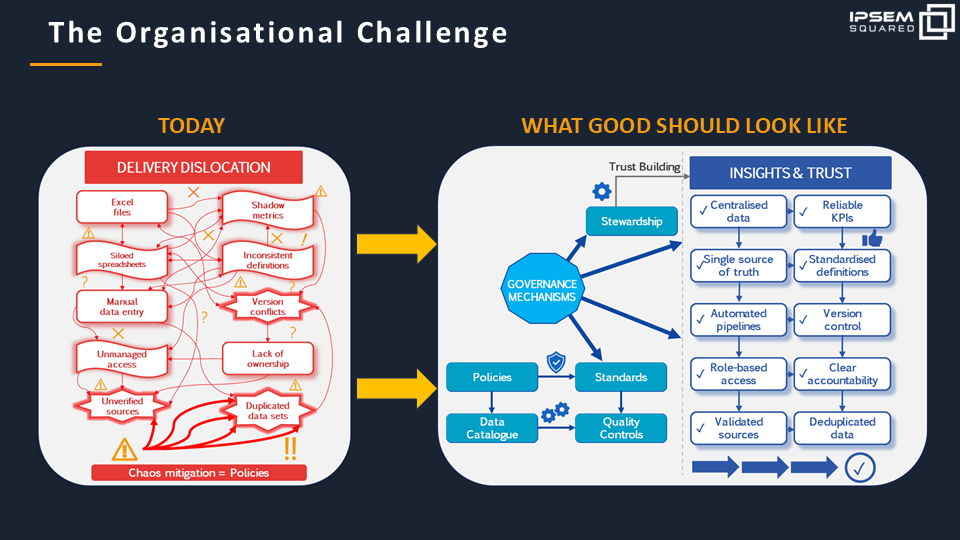
The other differentiator is how we treat the information problem. The key structural weakness with how most of this is done is that organisations collect their data and then try to fix it. We change the dynamic by going back to source and capturing the correct information at that point. This removes the unproductive impact that is felt by most organisations.
For sponsors, that means stronger investment clarity delivering better internal justification.
For agencies, it means scalable consistency and better insight.
For rights holders, it means stronger rights delivery, more defensible propositions, and stronger long-term relationships.
Artificial intelligence is a good example. Beyond the fact that AI is nowhere near 100% accurate, it is not a strategy, it is a capability that amplifies existing processes and information. If they are strong, AI enhances performance. If they are not, it accelerates inconsistency. Our perspective is that performance must come from the process as well as the platform.
What do you see as the most important trends shaping sponsorship in 2026, and how are they influencing your work?
The ESA 2026 Sponsorship Trends highlight an industry at an inflection point.
Artificial Intelligence rising to number one reflects the acceleration of technology across the sponsorship lifecycle. From insight generation to contract optimisation and reporting, AI offers significant enablement efficiency and analytical capability.
But what sits alongside AI in the rankings is equally important: Social Impact, Purpose and Community, and the continued emphasis on Measurement and Data. That emphasis on Measurement is particularly telling – it has featured inside the top 10 every year since 2021. That persistent presence is not a sign the industry is solving the problem; it is a sign the industry knows it has not.
Taken together, they all point to one theme: accountability.
We see sponsorship judged less on activity and more on evidence. Exposure is no longer sufficient; stakeholders want proof of value, impact and alignment. Social Impact and Sustainability have moved from narrative to expectation. Measurement is shifting from reliance on exposure-based metrics – impressions, reach and media value equivalency – which measure opportunity rather than impact or delivery, toward in-process evaluation and governance that tracks what was agreed, what was delivered and what value was genuinely created.
This is influencing our work in a very practical way. We are helping organisations to:
- embed measurement into planning rather than retro-fitting it
- align commercial and social objectives from the outset
- embed qualitative and non-financial measurement
- build reliable information frameworks across portfolios
- introduce technology in ways that supports decision-making rather than overwhelms it, plus provides usable insight instead of numbers.
The opportunity is significant, but only if the trends are interpreted comprehensively within a coherent structure rather than tactically.
How has sponsorship evolved in recent years, and what changes do you anticipate ahead?
Over the past few years, sponsorship has shifted from a marketing function to a strategic one.
Economic pressure, ESG scrutiny and technological acceleration have raised expectations. Sponsors are under more pressure to justify investment, Agencies are expected to demonstrate deeper strategic value, and rights holders must evidence delivery with greater transparency.
The industry has become more socially conscious. Investment in women’s sport, community initiatives and inclusive talent reflects a broader understanding that sponsorship carries responsibility as well as opportunity.
Looking ahead, sponsorship will continue to professionalise with:
- greater integration between commercial, brand and social objectives
- more structured investment review cycles
- increasing demand for transparency in reporting
- AI embedded into activities rather than sitting across the top.
The organisations that succeed will not necessarily be those with the most advanced tools, but those with the clearest, and cleanest, operating models.
How do you ensure balance between sponsors, agencies and rights holders?
They are inter-dependent – sponsors seek confidence and clarity. Agencies seek efficiency, strategic positioning, and justification / validation of their services. Rights holders seek scalability, and credible long-term partnerships.
When alignment is weak, friction appears – around measurement, expectations and delivery. Reporting becomes defensive rather than insightful.
Part of the reason for this is structural. In most cases, performance reporting is produced by the rights holder and delivered to the sponsor. When the party reporting on delivery is the same party responsible for it, objectivity is constrained by design. Agreed frameworks – built at the outset, not retrospectively – change that dynamic.
We create shared performance frameworks. When objectives, process, metrics and governance are agreed from the outset, conversations focus on enhancing value.
Sponsorship works best as part of a partnership ecosystem, not a transactional chain.
Is there anything else you would like to add?
The 2026 trends do not signal a more technological industry; they signal a more accountable one.
AI will not create trust on its own. Purpose will not generate confidence without evidence. Having data and volumes does not equate to clarity.
The industry does not have a measurement problem. It has a measurement prioritisation problem. The tools to count impressions and produce exposure reports are well developed. The processes to verify what was delivered, capture qualitative impact and build trusted information frameworks are not. That is where the real work is.
To maximise commercial return, social impact and durable partnerships, a team needs to operate within disciplined processes, supported by trusted information, enabled by appropriate technology.
Focusing on the next trend will not deliver the strongest opportunities. Building on the right foundations, put in place in the most effective way, will allow the identified trends to create sustainable value.