

Steve Olechowski
Co-founder and CEO
Can you tell us in less than 100 words what Blinkfire Analytics does?
Blinkfire Analytics is a SaaS platform for optimizing sponsorship sales for brands and rights holders. Our mission is to be on the desktop of anyone within a sports & entertainment organization while helping those people and companies make better, more informed business decisions that ultimately generate value and revenue.
Who are your customers?
We work with some of the world’s top teams, leagues, federations, brands, athletes, creators, and agencies — with a footprint across six continents.
Sports range from football, basketball, and soccer to rugby, handball, and padel. We track over 40+ sports in Blinkfire.
As well as the unrivalled insight and in-depth analysis in our articles, we run the UK’s biggest football podcast network Some of our European customers include La Liga, Real Madrid, Giants Gaming, Valencia CF, FC Bayern, Motherwell FC, Inter, Juventus FC, ESL Gaming, Austrian Bundesliga, Caixabank, AC Milan, Red Bull Leipzig, AS Monaco, Fulham FC, Real Racing Club, Wimbledon, French Tennis Federation, Watford FC, Moto GP, Marseille, and Hampshire Cricket.
What makes you stand out from your competitors?
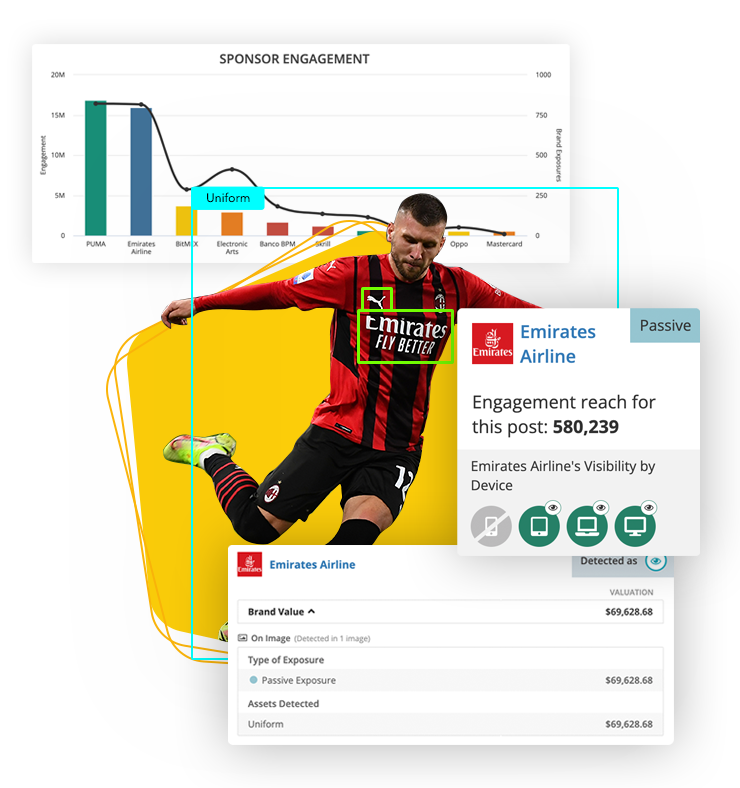
For starters, we own our technology stack, including our computer vision and artificial intelligence. BrandSpotter™is our patented, proprietary computer vision (CV) and artificial intelligence (AI) technology that is used for logo recognition, asset & scene detection, and passive vs active exposure. Because we don’t use a third-party for our CV and AI, we have the unique advantage of not only making updates in real-time, but also leveraging our engineering team and expertise to quickly and efficiently create new and better ways for our tech + products to work.
We also focus on the entire sales lifecycle: from carving out and pricing inventory to tracking delivery, enabling account management for partners, and reporting on exposure and valuation. I think a lot of the market only focuses on the last thing in that list.
What are the current trends in your business area, and how are they affecting how you work and how you deliver on strategy?
There are two major trends we are seeing that have shaped our product offerings in the last couple of years: 1) A focus on digital campaign executions, including presales and pricing; we’ve just released Blinkfire’s 2021 Insights Report that covers quite a few digital and social activations and why this trend is so important in sports and sponsorship. 2) An increase in data warehousing of data versus just looking at PowerPoint results.
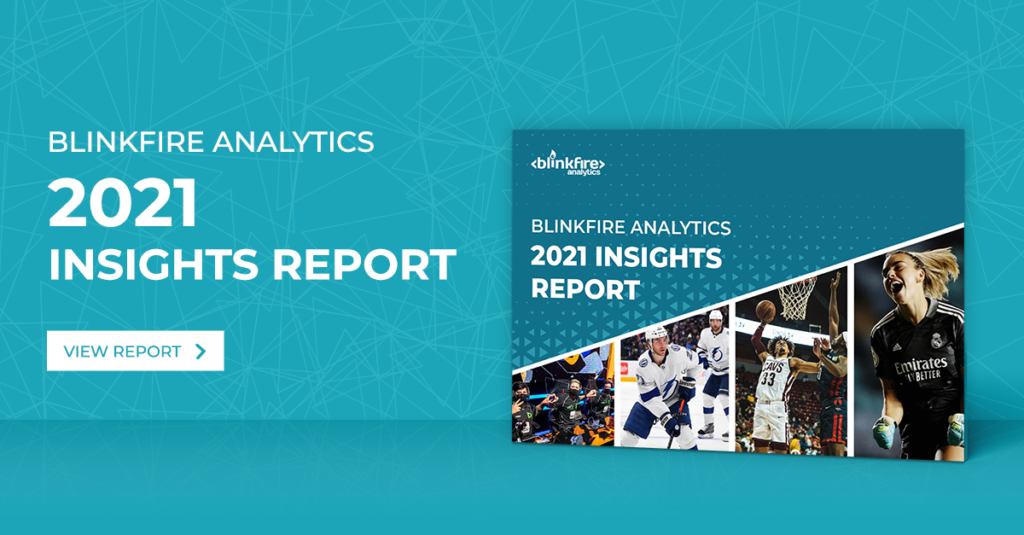
First, in most cases, “passive” sponsorship exposure and valuation is a known quantity, and most of this sponsorship inventory has already sold to capacity. Teams don’t need data to sell more adboards – that’s saturated. What social and digital has opened up is a greenfield to carve out more creative executions with sponsors that fans can engage with directly. For example, based on data in our 2021 Insights Report, partnering with sports teams to run digital activations returns 3-5x better engagement rate compared to running promoted ad campaigns.
Second, brands and rights holders are strategically warehousing sponsorship data beyond the traditional “static” reports that have been delivered. For instance, a brand may want to correlate data from Blinkfire with another provider that provides purchase funnel data. On the rights holder side, they want to combine sponsorship engagement data with their CRM and ticketing data. As more and more of these organizations hire skilled business intelligence people, integrating data APIs into their data warehouses has gone from a “nice to have” to a “must-have,” which we have increased our capabilities to support.
What challenges have you encountered, and how have they been overcome?
The past two years have come with challenges, especially during sports’ three-month timeout, no fans in the stadium, organizations laying off + rehiring. With these challenges, we’ve seen many opportunities – from within Blinkfire and across social media and sponsorship.

Teams have become more creative with their content. Numerous content trends that were popular during the sports lockdown have continued as a staple. For example, behind-the-scenes training sessions, cooking, and trivia. Instead of teams needing to make good with sponsors back in 2020 and, in some cases 2021, these content strands now have specific sponsors attached to them.
A second challenge that is always a part of our business is educating the sponsorship sales world on how digital and social works. The default approach is for salespeople to sell social and digital activations as they had in the past with assets that would appear on television – to sell an impressions number based on a passive television estimation. We’ve gone from something that wasn’t exactly measurable (broadcast signals) to something that’s almost exactly measurable (IP based streams). Going from a blown-out estimation to a more measurable approach will cause people to look twice and question the correctness of the “new” thing, which though more accurate, may show numbers that are significantly more or less than they are used to. They don’t think the old, estimated numbers were wrong; they assume the “new” numbers are wrong.
We’ve overcome this by developing methodologies and processes that are transparent. There are no black boxes or magic formulas – it’s all explained right there in front of the customer. Where are the CPMs and CPEs coming from? We show that. How is visibility calculated? We show that. We’ve achieved this by spending a lot of time educating customers on how users in social media can engage with content, which may be a stronger signal than a passive “impression.” We take for granted working in the digital world that everyone understands this, but I think we are still crossing the chasm in the sponsorship world from an industry that worked on estimated and extrapolated numbers to one of exact measurement. We will get there though.
How has Blinkfire evolved as social media, sports, and sponsorship have changed over the past few years?
More so than ever, social media took control out of the hands of the media companies and put it in the hands of teams, leagues, brands, athletes, etc. Social media allows rights holders and brands to control the message that gets published, and then the media companies and fans amplify it. As we’re seeing, and what we’ve believed in since the start of Blinkfire – everyone is a media company and has the ability to create engaging content.
The ability for brands and rights holders to have an end-to-end solution that not only tracks, monitors, and reports on partnerships, but also allows for better, more efficient selling is key. Social media is giving teams more content that can be paired with a sponsor, and brands are forgoing paid media to tie their name to a team, athlete, or TikToker – and leverage their loyal, engaging audience.
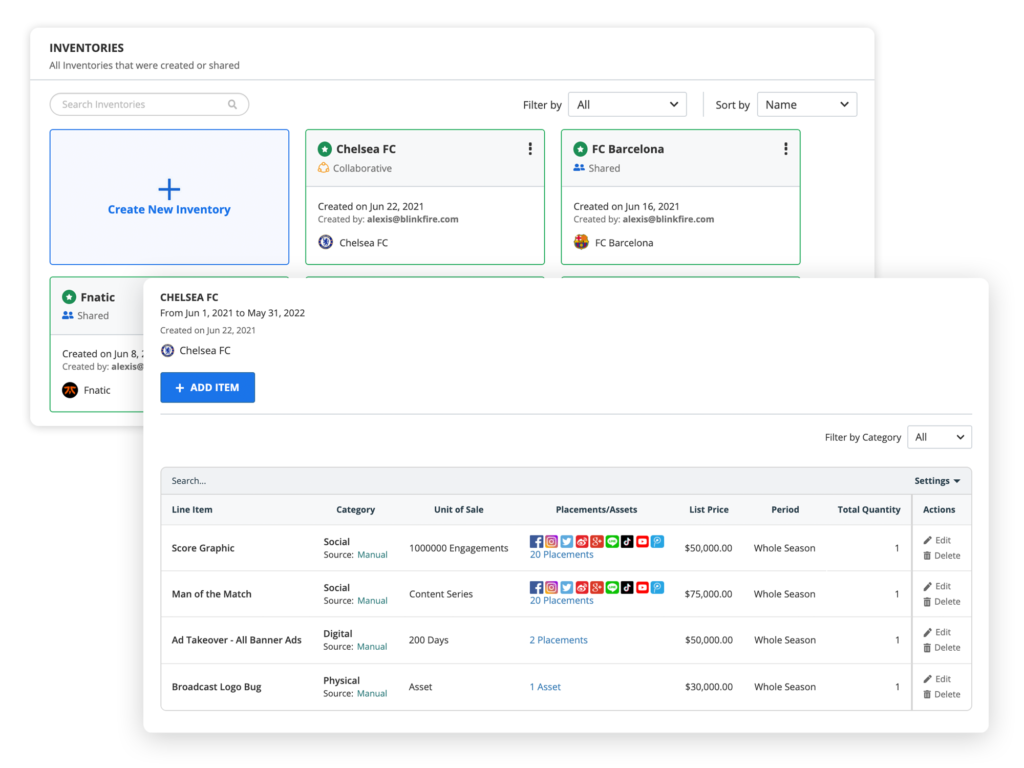
Because of social media’s rapid evolution, Blinkfire aims to be on the desktop of anyone in sports and sponsorship, so we move with the puck. Beyond our core capabilities of sponsorship valuation and social media analytics, we’ve created tools to better help rights holders and brands manage their inventory items for digital and social activations. Additionally, we’ve built a real-time ad rates engine that allows our customers to understand the price of CPEs, CPVs, and CPMs across social media and how they are trending. On top of that, what we continually hear from customers and non-customers alike is – “I want to sell this content series, I don’t know how much to charge.” Using our Rate Card generator enables users to go into meetings, renewals, sales pitches, etc. with defensible, measurable data. Predictive analytics takes past social media performance to understand future performance and how content should be priced based on real-time ad rates. These tools have been built in the past year and a half as the industry has changed and evolved.